The
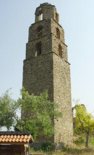
guest who comes to S. Mango
today can admire several remains
of the past, for example the belfry of the old church of the Del
Giudice palace mentioned above, as well as the chapel of S.
Donato e della Trinità, the new parish church,.
|
Several
generations took it in turns to uphold the feudal system, amongst which
there were such well known names as Mendoza,
D’Aquino, Del
Pezzo and Sanfelice.
In the end, towards the middle of the 18th century the Del
Giudice took over. Their descendents still live in the magnificent 18th
century palace (the stability of a large part of the building is in
a precarious, almost dangerous condition) placed on the town’s main
road.
At
the beginning of the 19th
century S. Mango
experienced a further progressive period,
this time in a political-administrative sense, because with the
enforcement of the napoleonic reform it was appointed capital of a large
commune consisting of seven villages. However, the phase of this
independent commune was a short one. On the 1st January the
capital was transferred to the nearby Sessa,
of which S. Mango became a
destrict.
After
the national Unification the subject of emigration became a main issue in
the history of S. Mango. To
begin with the destination was the United States of America, where even
now the presence of the S. Mangese is flourishing. After the war, however,
emigrants headed for Venezuela, and then later for the countries of
central Europe. Regardless of their destination these emigrants have
maintained the traditions and costumes of their home town and above all
they still worship the patron saint S.
Rosalia, which has carried on since the middle of the 17th
century.
The
guest who comes to S. Mango
today can admire several remains
of the past, for example the belfry of the old church of the Del
Giudice palace mentioned above, as well as the chapel of S.
Donato e della Trinità, the new parish church. The Feola
palace and also the palace of Verta
in the district of Castagneta,
but above all he can enjoy the traditional hospitality of the inhabitants
and the natural flavour of the food products.
|